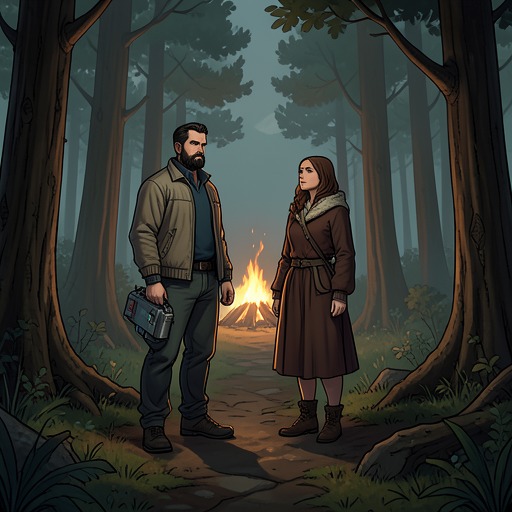
Captain Kidd's Smith & Wesson revolver
News of the WorldCaptain Kidd's Smith & Wesson revolver is a working weapon whose significance lies in both its limits and its transfer of trust. Acquired from Britt Johnson in exchange for Kidd’s outmoded Slocum, it becomes part of the pair’s precarious defense on the road. Kidd checks, hides, and rations its ammunition; Cicada learns its safety and holds it herself. In the later ambush, the pistol’s small supply of cartridges makes every shot consequential.
Origin and Exchange
The Smith & Wesson enters Kidd’s possession during his encounter with Britt Johnson. Johnson asks to inspect the pistol Kidd has, and Kidd draws the revolver tucked behind his threadbare canvas coat and hands it over butt-first. Johnson recognizes that the Slocum is an antiquated, weak weapon, then lays it aside and gives Kidd his own Smith & Wesson. The exchange is also an acknowledgment of obligation: Johnson says he owes Kidd for taking on a dangerous man. Kidd, carrying a twelve-gauge shotgun as well, tries not to smile at the younger man’s concern for him.
The moment establishes a practical contrast between the two pistols. Kidd’s original Slocum is treated as something fit for a child’s Christmas, while the Smith & Wesson is the better arm that Johnson entrusts to him. The exchange does not make Kidd well equipped. Rather, it replaces one conspicuously inadequate weapon with a more useful revolver, while leaving the older man to reckon with ammunition, storage, and the risks of using it.
A Weapon Shown and Concealed
As Kidd and Cicada travel beside the Red River, he tries to explain the revolver without relying on speech they share. He opens its cartridge cylinder, shows her the charges, snaps it shut, and indicates that he has it in case of trouble. He theatrically scans the trees, points the gun outward, and mimes firing before placing it in plain view on the wagon floor to his left. His conspicuous demonstration presents the weapon as protection, but also makes his handling of it part of an improvised effort to communicate with a frightened child.
That danger soon becomes immediate when Cicada signals that she has seen something ahead and Pasha calls out. Kidd checks the revolver’s loads, finds them dry, and lays it beside the driver’s seat, covering it with a canvas-wrapped flitch of bacon. He reminds himself that the .38 cartridges are hidden in the flour keg. A mounted U.S. Army company then rides into view. Kidd gets Cicada into the wagon bed, where she covers herself with her wool jorongo, and faces the approaching soldiers. The revolver is present but concealed; the scene does not say that he fires it at the patrol.
After the soldiers have been faced down, Cicada sits beside Kidd holding the revolver between her knees. She makes signs he understands as meaning good and free, and smiles for the first time. When Kidd carefully takes the pistol from her, engages its safety, and returns it to the left side of the seat beneath the bacon, he realizes she knows how to disengage the safety. The gun has passed briefly into her hands, and that handling reveals a competence that changes how he sees her. He imagines that, if the officer had reached for her, she would have cocked it and shot him at point-blank range. Its use here is therefore not simply to describe Kidd’s readiness: the revolver also marks Cicada as an active participant in her own defense.
Scarcity and Use in the Ambush
The limits of the weapon become explicit during the pair’s hurried night journey away from Almay and the Caddos. Kidd is willing to fight but knows he is poorly armed. He puts the revolver in his waistband on the right, with its butt forward, because he lacks a holster. There is only one box of cartridges, perhaps close to twenty rounds, and he has been unable to buy another. The shotgun offers little reassurance: it is a single-shot, twelve-gauge weapon loaded only with birdshot, and its loose safety lever might shift before Kidd could aim. His firearms provide some defense, but their condition and ammunition make that defense uncertain.
In the ravines, the revolver becomes an instrument of close, measured resistance. Kidd identifies the attackers’ arrangement as fire from both sides, including rifles and a handgun. When a Caddo carrying a rifle crosses between rocky outcrops, Kidd fires three times, chipping stone around him and scattering cedar duff and sumac leaves. He also fires twice toward a rifle flash within revolver range; the attacker cries out, and the rifle flies from his hand and lodges among the rocks. Kidd recognizes that disarming the man has not ended the danger, since the man may try to retrieve it.
The exchange costs ammunition. Kidd fires again at another attacker, misses despite having the man in his sights, and then reloads, with twenty cartridges left. The count gives the revolver’s action a precise material limit: each hurried shot reduces a small reserve that Kidd cannot easily replenish. Yet the weapon contributes to keeping the attackers at bay, and Cicada returns from the danger to face them again. Kidd praises her, while she answers with a grave nod and turns her attention back to the enemy.
Significance
The revolver repeatedly joins protection to vulnerability. Its exchange improves Kidd’s armament, but does not erase the shortage of cartridges, the missing holster, or the dangers of the shotgun beside it. It is deliberately displayed to Cicada as reassurance, hidden when the soldiers arrive, then placed in her hands after their encounter. Later, in the ravines, it becomes a weapon whose limited ammunition must be spent under pressure. Its changing position—from Kidd’s coat, to the wagon floor beneath bacon, to Cicada’s grip, to Kidd’s hand in the fight—tracks the shifting demands of their journey and the trust developing between them.